Trucker Kids T-Shirts
If Diesel Ain_t Burnin_ Then Ain_t Earnin_ Trucker Kids T-Shirt
by Dunnhlpp
$14 $19
Description: Consolidated Freightways (CF), was an American multinational LTL (Less Than Truckload) freight service and logistics company founded on April 1, 1929, in Portland, Oregon, and later relocated to Vancouver, Washington. At its height, the company possessed over 350 terminals, employing more than 15,000 truck drivers, dockworkers, dispatchers and management. Consolidated Freightways was once the nation's number one long-haul trucking company and the 3rd largest-ever U.S. bankruptcy filing, ceasing business in 2002.
Description: Before the proliferation of large truck stop chains made them a ubiquitous sight along the interstates, one-off mom-and-pop truck stops found on the two-lane highways were the norm, and the Tiki Oasis Truck Stop is one such example. Located at the junction of I-80 and US-51 in the LaSalle-Peru area of Illinois, Tiki Oasis decided to run with the tiki/exotica craze and theme their truck stop as such. From the decor of the motel rooms to signage throughout the facility, the Tiki Oasis was a little slice of Polynesian paradise right in the heart of the Midwest.
Description: Reimer Express Lines was founded in 1952 when 19-year-old Donald S. Reimer of Steinbach, Manitoba convinced his father and brothers to join him in starting a trucking company. Their original route was between Winnipeg and Windsor, Ontario, with Winnipeg as the head office. By December, Reimer added Windsor to Vancouver, and had extended to Toronto by 1956. In 1968 Reimer was acquired by Canadian conglomerate Neonex, but in 1971, the Reimer family bought the company back. Reimer continued to grow and expand through before ultimately being sold again in 1997 to Roadway, who themselves would be bought just six years later by Yellow. Yellow operated Reimer as an independent line until 2019, at which point the Reimer name was retired.
Description: If you lived in the south during the '50s through the '70s, you probably saw more than your share of 'The Big R' tankers running down the highways. Ryder Tank Line was founded in 1954 in Greensboro, North Carolina, and provided reliable contract tanker service throughout the southern states for nearly three decades.
Description: California Motor Express (CME) trucking was founded in the early '30s in Los Angeles, California. As their name might imply, they served all of California and California only. With their primary route being I-5 between SoCal and NorCal, and serving major cities in between, CME really did 'carry California.'
Description: Founded in the mid-sixties in Overland Park, Kansas, American Freight System grew from a Midwest regional short haul carrier to a national long haul powerhouse inside just two decades. By the mid-eighties, American was operating close to 200 terminals from coast to coast with a fleet of 1,600 tractors and 5,200 trailers, making them the fourth-largest trucking company in the United States at the time. Unfortunately, the company sold themselves to an investment group in 1988 that promptly stripped the company for a quick profit, leaving American Freight System as a footnote in the history books.
Description: A glossy blue truck carries a giant rubber duck under the word “CONVOY” with a classic CB quote below: “You Got a Copy on Me, Pig Pen – C’mon.” Referencing the iconic trucker anthem, this bold, humorous design is perfect for fans of 70s trucker culture and convoy lore.
Rubber Duck Convoy CB Radio Quote Blue Comic Style Kids T-Shirt
by Beelook
$14 $19
Description: Motor Freight Corporation (MFC) was started in 1926 by Harry Adams with one truck operating between Terre Haute and Brazil, Indiana. About a year later another truck was added and service was extended to Bloomington and Bedford and a little later to Indianapolis. Adams would proceed to buy up smaller truck lines year over year until the '60s when MFC was operating terminals in Illinois, Indiana, Missouri, Nebraska, and Tennessee, and maintaining ICC operating authority on multiple routes. Increasing public interest in deregulation of the trucking industry in the early '70s had Adams seeing the writing on the wall, and he looked for a buyer for MFC, finding one in Branch Motor Express out of Pennsylvania.
Description: C.W. McCall's song 'Convoy' reached the number one position on the pop and country music charts in January 1976. The song was about truckers using CB radios to rebel against the new 55 mph federal speed limits, a theme so popular and topical, that the single sold over two million copies upon release. Midland decided to market a CB radio called the 'Convoy Buddy' to McCall fans, and while its 4 watts won’t get you from New Jersey to Omaha, Nebraska, like it did in the song, the radio was a nice unit. In 1978, the movie Convoy was released, based on McCall's song, that featured a new version of the track, written specially to track with the events of the film. The movie injected renewed in interest in the song and the Convoy Buddy radio sets.
Description: J. Harwood Cochrane founded the Overnite Transportation Company in Richmond, Virginia back in 1935 with an initial fleet consisted of one tractor, one trailer, and one straight truck. Overnite saw steady growth in its early years, fueled by contracts with the region's big tobacco producers. The company went public in 1957 and was listed on the New York Stock Exchange in 1962. Through the 1960s, 1970s, and 1980s Overnite grew through acquisition of smaller carriers or the assets of bankrupt competitors. In 1982, Overnite received authorization to operate in all 48 states of the contiguous US, allowing it to grow outside its home market in Virginia. By the mid-1980s, Overnite operated in 33 states plus Washington, D.C.
Description: In 1921, Harry Zabarsky and his brother, Mickey, started St. Johnsbury Trucking (SJT) with a single truck, and within a few years, had a growing fleet. Based in St. Johnsbury, Vermont, SJT grew to serve the northeastern U.S., and much of eastern Canada. The company grew and expanded heavily through acquisitions of trucking companies, operating terminals throughout Delaware, New England, New Jersey, New York, Pennsylvania, and Vermont. The mid '80s saw fortunes turn for SJT in a post deregulation trucking industry, and by the end of the decade, it was clear the company was in trouble. After more than seven decades of business, St. Johnsbury Trucking officially closed its doors on June 14, 1993, leaving 4,400 hardworking people out of work.
Description: Lee Way Motor Freight was founded by Robert “Whitt” Lee in 1934 in Oklahoma City, Oklahoma. Lee Way grew quickly, adding drivers and equipment, all while developing a reputation for safety and reliability. By 1947, the company had 225 pieces of equipment and added routes in Kansas and Missouri. That year, the company acquired another trucking company that expanded its fleet and operating authority, an expansion strategy Lee Way would follow for decades into the future. By 1975, Lee's sons decided to sell the company and by the time deregulation hit, Lee Way was in a downward spiral. Lee Way had expanded to 5,000 employees and 100 terminals in 25 states by 1984,but Lee Way's then owner, Commercial Lovelace, elected to shutter the line.
Description: Lincoln Hawk is a truck driver who also arm wrestles for extra cash. Hawk's estranged wife Christina, who is suffering from heart disease, asks that Hawk pick up their young son Michael from military school and develop a relationship with him; Hawk had left them ten years earlier. Michael's wealthy grandfather, Christina's father, Jason Cutler, believes that Hawk has no right to be in his grandson's life. Michael distrusts Hawk initially and treats him with contempt at every turn.
Description: Founded in Pocatello, Idaho in 1913 by Clarence Garrett as a luggage transfer service for railroad passengers, Garrett Freight Lines grew to become the fifth-largest freight carrier in the U.S. and a major employer in Pocatello for nearly seven decades. Garrett was purchased in 1977 by a private equity firm, and then sold to ANR, an oil and gas concern, in 1978. ANR purchased three trucking companies with authority to operate routes from coast-to-coast. ANR redesigned the familiar green-and-gold Garrett logo, replacing it with a multicolored U.S. map design, and moved the firm’s headquarters to Denver, but eventually divested its trucking businesses, leaving Garrett to be absorbed by other entities.
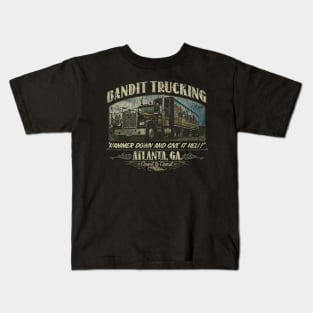
Description: Smokey and the Bandit is a 1977 American action comedy film that follows Bo "Bandit" Darville and Cledus "Snowman" Snow, two bootleggers attempting to illegally transport 400 cases of beer from Texarkana to Atlanta. While the Snowman drives the truck carrying the beer, the Bandit drives a 1977 Trans Am to distract law enforcement (called blocking) and keep the attention off the Snowman. During their run, they are pursued by Texas county sheriff Buford T. Justice. Smokey and the Bandit was the second-highest-grossing domestic film of 1977 in the United States.