

Tank Tops

Description: Auguste Toulmouche (1829–1890) was a French academic painter best known for his elegant portraits and genre scenes of fashionable women. La Fiancée hésitante depicts a beautifully dressed young woman appearing lost in thought and uncertainty as she prepares for marriage. Her elegant clothing, refined interior, and delicate pose reflect the fashionable upper-class life of 19th-century France. The painting’s title suggests a moment of hesitation, inviting the viewer to wonder about the woman’s feelings toward her upcoming marriage.

Description: Joseph Christian Leyendecker (1874–1951) was one of the most influential American illustrators of the early 20th century. He became famous for his magazine covers and advertising illustrations, particularly for The Saturday Evening Post and Arrow Collar advertisements. Vacation Maidens, Golf or Tennis (1907-1910) captures the fashionable, energetic spirit of leisure in early 20th-century America. The work presents youthful women associated with popular vacation activities such as golf and tennis, emphasizing stylish clothing, athleticism, and modern femininity. Leyendecker’s elegant figures, crisp lines, and carefully designed clothing give the image a polished, glamorous quality typical of his commercial illustrations.

Description: Harold Rudolf Foster was a Canadian-American comic strip artist and writer best known as the creator of the comic strip Prince Valiant. This illustration shows a woman looking at cards, a crystal ball, while on fours in the middle of the astrological wheel as if consulting for her fate.

Description: Osmar Schindler (1867–1927) was a German painter associated with the late 19th-century academic and historical painting tradition. In David and Goliath (1888), a lithograph, Schindler emphasizes a striking visual contrast between the youthful David and the imposing Goliath. David’s smaller, agile figure stands in sharp opposition to Goliath’s massive and powerful form, highlighting the tension between vulnerability and strength. Through dramatic scale, movement, and composition, Schindler captures the courage of the seemingly weaker figure facing an overwhelming opponent.

Description: Vincent van Gogh by his friend John Peter Russell (1886) is a striking portrait of the famous Dutch artist Vincent van Gogh. Painted in a realistic yet expressive style, Russell captures Van Gogh’s intense gaze and strong personality. The warm tones and detailed brushwork emphasize his distinctive features, making the portrait a memorable representation of the artist during his time in Paris.

Description: Young Lady in 1866 is a painting by French artist Édouard Manet. It shows a young woman, his favorite model Victorine Meurent, dressed in an elegant black gown, holding a small bouquet of flowers. Manet uses simple colors and a relaxed pose to create a modern, natural portrait. The painting reflects his interest in everyday life and his innovative style, which helped shape modern art.

Description: The Laughing Fool by Jacob Cornelisz van Oostsanen depicts a foolish or humorous figure with an exaggerated expression, reflecting the artist’s interest in human behavior and satire. Van Oostsanen (c. 1472–1533) was a Dutch painter and printmaker, known as one of the early masters of Northern Renaissance art.

Description: Le Chiffonnier aka The Ragpicker (1869) by Édouard Manet depicts a poor working-class man collecting discarded materials in the streets of Paris. The painting highlights the harsh realities of urban life and Manet’s interest in everyday people. Manet (1832–1883) was a French painter who helped shape modern art and is considered an important figure in the development of Impressionism.

Description: Reading Monkey (1889) by Gabriel von Max is a playful painting showing a monkey seriously reading a book. The work humorously gives the animal human-like qualities, suggesting intelligence and curiosity. Von Max (1840–1915) was an Austrian professor of history painting known for his detailed paintings of animals, especially monkeys, often using them to reflect human behavior.

Description: Charles Mengin (1853–1933) was a French academic painter known for his historical, mythological, and literary subjects. His works often portrayed dramatic and emotional figures, reflecting the academic style popular in 19th-century France. His Sappho (1877) depicts the famous ancient Greek poet Sappho in a moment of deep emotion and contemplation. Shown reclining against a richly decorated setting, Sappho appears absorbed in thought, reflecting themes of love, longing, and melancholy associated with her poetry. The painting combines classical imagery with the dramatic beauty and emotional intensity characteristic of 19th-century academic art.

Description: Sir Thomas Lawrence (1769–1830) was a renowned English portrait painter who became one of Britain’s leading artists of the late 18th and early 19th centuries. He was known for his elegant portraits of royalty, politicians, and other prominent figures, and later became President of the Royal Academy. His Satan (1796–97) presents the fallen angel as a dramatic and imposing figure. Lawrence uses strong contrasts of light and shadow to emphasize Satan’s intense expression and powerful presence. The painting reflects the Romantic-era fascination with dramatic religious subjects, emotion, and the supernatural.

Description: Mårten Eskil Winge (1825–1896) was a Swedish painter and professor at the Royal Swedish Academy of Fine Arts, best known for his dramatic paintings inspired by Norse mythology. His interest in Nordic legends began early in his life and became a major theme throughout his career. His Thor (1872), also known as Thor’s Fight with the Giants, portrays the Norse god Thor as a powerful and fearless warrior, wielding his hammer Mjölnir while battling giants. The dramatic composition highlights Thor’s strength and courage and reflects the 19th-century European fascination with Norse mythology. The painting was first exhibited at Sweden’s Nationalmuseum in 1872 and was very well received.

Description: Joseph Wright of Derby’s "The Alchemist Discovering Phosphorus" (1771) depicts an alchemist in a dark laboratory discovering phosphorus. The glowing substance creates a dramatic light that illuminates the figures and objects around him. The painting combines scientific curiosity with a mysterious, almost spiritual atmosphere, reflecting the growing interest in science and experimentation during the Enlightenment.

Description: Ivan Kramskoy was a prominent Russian realist painter and a key figure in the Peredvizhniki movement, known for his insightful portrayals of Russian society, psychological depth, and masterful technique in both portraiture and genre scenes. Kramskoy’s Girl with a Cat (1882) captures the quiet intimacy of a young girl holding her cat, with both figures rendered in exquisite detail. The girl’s calm expression and the soft fur of the cat reflect the artist’s mastery of realism. This portrait beautifully conveys the bond between human and animal, showcasing Kramskoy’s skill in capturing both emotion and naturalism.

Description: Pavle Paja Jovanović (1859-1957) was a distinguished Serbian artist known for his vivid historical, genre, and portrait painting. The Falcon Trainer captures a moment of serene intensity, as a falconer carefully tends to his bird, symbolizing the deep bond between man and nature. The detailed realism in the falconer's attire and the bird’s poised stance reflects Jovanović's skill in portraying both human emotion and the natural world. The rich textures and vibrant colors in the composition evoke a sense of timeless tradition, highlighting the ancient art of falconry.

Description: Julius Kronberg (1850-1921) was a renowned Swedish painter known for his masterful depictions of historical, mythological, and biblical themes, blending classical techniques with emotional depth. Kronberg’s painting captures the poignant moment when young David soothes King Saul with his harp. For fans of classical and biblical art, it’s a timeless representation of one of scripture’s most iconic moments.

Description: Witches Going to Their Sabbath (1878) by Luis Ricardo Falero, a Spanish-born artist known for his captivating depictions of the supernatural. This stunning painting captures a dramatic and haunting image of witches soaring on broomsticks through misty skies, their flowing robes and wild hair embodying the dark magic of the occult. A moonlit scene of forbidden beauty, perfect for those drawn to fantasy, mystery, and the mystical.

Description: Self Portrait Blue 2 by Pablo Picasso (1901) is a striking example of his early Blue Period, capturing the artist in a moment of introspective melancholy. The painting is characterized by cool, monochromatic blues and somber tones, reflecting themes of isolation, poverty, and emotional depth. Picasso's angular features and contemplative expression convey a sense of inner turmoil, making this piece a poignant representation of his struggles during this formative time in his career.

Description: The First Murder (Le Premier Meurtre) by Léon Jean Basile Perrault (1899) depicts the biblical scene of Cain and Abel, the first murder in history. This dramatic, emotional painting captures the tragic moment of Cain's violent act, with a powerful use of light and shadow that enhances the intense atmosphere. Perfect for fans of classical art, religious themes, and powerful narrative imagery, this masterpiece evokes themes of guilt, sin, and the consequences of betrayal.

Description: The Devil Skating When Hell Freezes Over by John Maler Collier (circa 1894) offers a captivating, darkly humorous twist on classical themes. The painting depicts the Devil, traditionally a figure of torment and evil, skating on a frozen lake in Hell—an ironic representation of a place where the impossible happens. Collier’s work is full of Victorian-era wit, blending surreal imagery with a playful critique of mythological and religious ideas.

Description: This iconic painting from 1850 brings to life a dramatic scene from Dante's "The Divine Comedy" showcasing the detailed realism and emotional intensity of William Adolphe Bouguereau. It is a masterpiece that resonates with fans of classical art, literature, and powerful imagery.

Description: René Magritte's enigmatic painting called "Not To Be Reproduced" (La reproduction interdite) from 1937 shows a man in a black suit looking at his reflection in the mirror but the reflection shows his back. Beside him lies a book by Edgar Allan Poe called "Les adventures d'Arthur Gordon Pym"

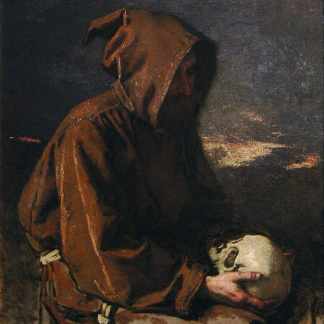
Description: Magdalene with a Skull by Mateo Cerezo captures a poignant moment of reflection, as Mary Magdalene, often depicted in religious art as a penitent sinner, holds a skull in her hands. This 17th-century painting combines symbolism and spiritual depth, emphasizing themes of mortality, repentance, and the fleeting nature of life. The dramatic use of light highlights Magdalene's contemplative expression, while the skull symbolizes both death and spiritual awakening.

Description: Boy Blowing Bubbles by Édouard Manet (circa 1867) captures a moment of innocence and playful leisure, depicting a young boy intently blowing soap bubbles. The painting, with its bold brushstrokes and modern style, reflects Manet's revolutionary approach to realism, emphasizing naturalism and a sense of spontaneity. This charming yet subtly profound piece highlights themes of youth, fleeting beauty, and the simplicity of everyday life.

Description: Boys in Sailor’s Striped Vests (1919) by Zinaida Serebriakova is a charming example of Russian Realism with elements of Impressionism. The painting captures two young boys in striped sailor vests, evoking a sense of innocence and playfulness. Serebriakova’s soft brushwork and focus on light and color give the work a fresh, lively quality. As a part of the Russian Realist tradition, the piece emphasizes naturalism, everyday life, and the depiction of human emotion with a subtle impressionistic influence. This artwork reflects Serebriakova’s talent for blending realism with a delicate, modern touch.


Description: A minimalist black and white, pen and ink digital line drawing of a hand doing the peace sign
PEACE Tank Top
$21



